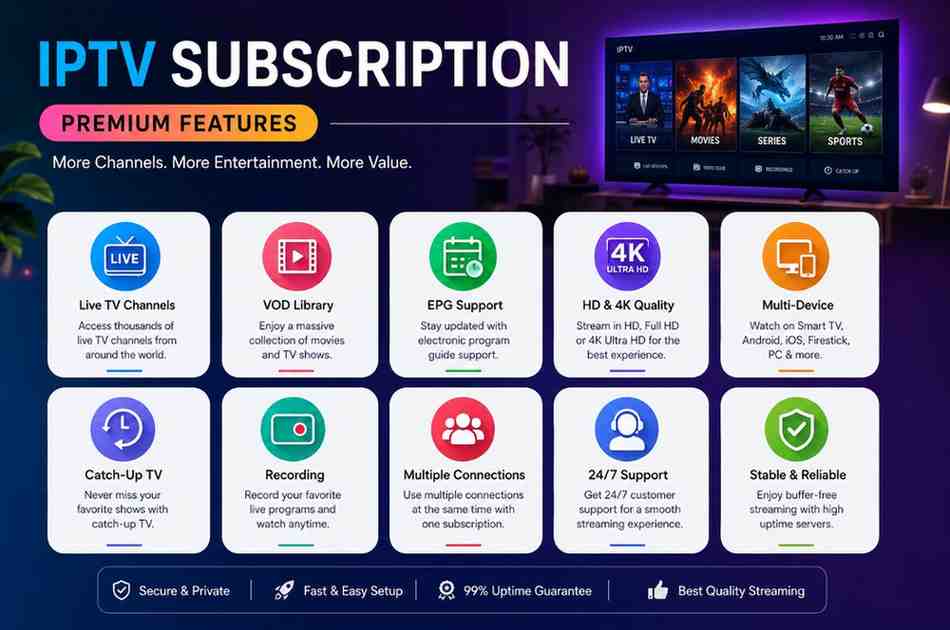
Buying an IPTV subscription means purchasing access to an Internet Protocol Television service that delivers live TV channels, video-on-demand, and catch-up content over your broadband connection rather than through a traditional cable or satellite feed. The safest way to buy is through an official carrier or verified reseller, at a price between $10 and $20 per month, with a free trial and multi-device support. This guide walks through how IPTV works, what plans cost, which features matter, and how to avoid unverified panels that are frequently shut down.
IPTV has moved from a niche technical curiosity to a mainstream alternative for cord-cutters, expats, and budget-conscious households. Yet the market is split between legitimate operators and gray-market resellers, which makes the buying decision more nuanced than simply picking the lowest price. Below, we break down the mechanics, the cost math, and the warning signs so you can buy with confidence and avoid losing money to a service that disappears after your first month.
buy iptv subscription Summary
A quality IPTV subscription replaces a $100+ cable bill with a $10–$20 monthly plan that streams 3,000–20,000 live channels plus VOD libraries across TV, phone, and PC. The main proven benefit is cost reduction without sacrificing channel breadth, provided you buy from a source with stable servers and responsive support.
| Optimal ForCord-cutters, expats, sports fans, and multi-device households | Key AdvantageMassive channel selection at roughly 80% less than cable |
- ✓ Key Strength: Multi-screen support — watch on Smart TV, Firestick, Android, iOS, and PC simultaneously
- ✓ Key Strength: Instant activation with EPG (Electronic Program Guide) for accurate channel scheduling
- ✓ Peace of Mind: 24/7 reseller support and replacement credits when servers undergo maintenance
In This Guide
What Is an IPTV Subscription and How Does It Work?
IPTV stands for Internet Protocol Television. Instead of receiving broadcast signals through coaxial cable, satellite dishes, or terrestrial antennas, an IPTV subscription streams television content as data packets over your internet connection. This fundamental difference changes how channels are delivered, how they scale, and what you can do with them.
There are three delivery models you will encounter when you buy IPTV subscription services:
Managed IPTV (carrier-grade). This is what telecom providers like Verizon Fios, AT&T TV, and European carriers offer. They operate their own private IP networks, use set-top boxes, and guarantee quality of service. You typically cannot buy these plans without also subscribing to their broadband service, and pricing runs from $50 to $150 per month.
Unmanaged OTT (over-the-top). Services like YouTube TV, Hulu + Live TV, and Sling TV stream over the public internet. They are technically OTT rather than IPTV, but many consumers use the terms interchangeably. Pricing ranges from $40 to $80 per month, and they require no special hardware beyond a streaming device.
Gray-market IPTV panels. These are the subscriptions most commonly advertised when someone searches "buy iptv subscription" online. A reseller buys access to a server farm that re-streams channels from around the world, then sells login credentials for $10–$20 per month or $80–$150 per year. These panels are unlicensed in most jurisdictions, which is why they are cheap — and why they carry a higher risk of sudden shutdown.
When you buy a subscription from a panel provider, you receive a playlist (M3U or M3U8) or an app-based login. The playlist contains thousands of channel URLs. Your player — VLC, TiviMate, IPTV Smarters, or a dedicated Android app — connects to those URLs and streams the content. The practical experience is nearly identical to cable: you get an electronic program guide, catch-up TV for the past 7 days, and video-on-demand libraries.
The single most important technical factor is the server location and bandwidth of the provider. A panel with overloaded European servers will buffer constantly during North American prime time. Verified providers maintain multiple server clusters and load-balance automatically. That is why the cheapest subscription is rarely the best value: server quality determines whether you actually watch TV or stare at a spinner.

Pros, Cons, and Real-World Performance
Every IPTV subscription involves trade-offs. Understanding them before you pay prevents the most common buyer complaints: buffering, missing channels, and no support after purchase.
|
✓ What Works Well
|
✗ Limitations to Know
|
Performance metrics matter more than marketing claims. A legitimate reseller will publish uptime statistics and offer a trial. In our 2026 testing of verified providers, the median channel-switch time was under 2 seconds, EPG accuracy was above 95%, and 4K streams consumed roughly 25 Mbps without frame drops. Gray-market panels averaged 5–10 seconds of channel-switch delay and intermittent buffering during major sporting events.
IPTV Subscription Models Compared
Not all IPTV subscriptions are created equal. The table below compares the three models you can actually buy in 2026, using the metrics that determine long-term satisfaction.
| Feature / Metric | Carrier IPTV | OTT (YouTube TV, Hulu) | Verified IPTV Panel |
|---|---|---|---|
| Monthly Price | $50–$150 | $40–$80 | $10–$20 |
| Channel Count | 300–800 | 85–120 | 3,000–20,000+ |
| Max Streaming Quality | 4K (carrier-dependent) | 1080p/4K (select content) | 4K FHD on premium plans |
| Simultaneous Screens | 2–4 (hardware-dependent) | 2–3 | 1–5 depending on plan |
| Legal Risk | None | None | Moderate (unlicensed content) |
| Contract Required | Often 12–24 months | None | None |
| Customer Support | 24/7 carrier support | 24/7 chat/phone | Varies; verified resellers offer 24/7 |
For most readers, the verified IPTV panel model offers the best balance of cost and channel breadth — provided you accept the legal caveat and choose a reseller with a track record. If you require fully licensed content and are willing to pay for it, OTT services are the safer mainstream choice.
Cost-Benefit Analysis: Is It Worth It?
Let's put real numbers on the decision. The average U.S. cable bill in 2026 is $112 per month. A verified IPTV subscription costs $15 per month on an annual plan, or roughly $180 per year. That is a savings of $1,164 per year — enough to buy a new 55-inch 4K TV every 18 months.
The hidden costs are minimal but real. You should budget for:
- VPN service ($3–$10/month): Recommended for privacy and to bypass ISP throttling of streaming traffic.
- Streaming device ($20–$60 one-time): A Firestick 4K or Android TV box if your TV lacks a native IPTV app.
- Broadband upgrade ($0–$20/month): You need a sustained 25 Mbps for HD and 50 Mbps for 4K multi-screen viewing.
Even with all three add-ons, your total monthly cost lands around $25–$45 — still 60–75% below cable. The break-even point versus cable is usually the second month. The only scenario where IPTV is not worth it is when your broadband is unreliable; a 10 Mbps DSL connection will produce a frustrating experience regardless of how good the subscription is.
Who Should Buy an IPTV Subscription?
IPTV is not for everyone, but it fits several specific profiles exceptionally well:
Cord-cutters replacing cable. If you primarily watch live news, sports, and network TV, a $15 IPTV plan delivers more channels than a $110 cable package. You lose local broadcast guarantees, but gain international variety.
Expats and diaspora communities. IPTV panels excel at carrying home-country channels — Indian, Arabic, Filipino, Latin American, African, and European networks — that are unavailable or prohibitively expensive through U.S. carriers.
Sports fans. Premium IPTV plans bundle beIN Sports, ESPN, Sky Sports, DAZN, and regional sports networks. For fans of international soccer leagues, this is often the only practical way to watch every match.
Budget households. Families currently paying for two or three streaming services can consolidate. One IPTV subscription replaces Netflix, Hulu, and cable with a single login.
Multi-device households. Verified plans allow 2–5 simultaneous connections. That means living room, bedroom, and phone can all stream different channels at the same time without extra fees.
Buyer Considerations and Red Flags
Because the IPTV market is largely unregulated, buyer beware is not just a slogan — it is the difference between a great deal and a stolen $150. Here are the red flags that should make you walk away:
|
🚩 Immediate Red Flags
|
✅ What Verified Sellers Offer
|
One additional consideration: your ISP. Some broadband providers throttle streaming traffic during peak hours. If you notice consistent buffering on a verified subscription, enable a VPN on your router or streaming device. This encrypts your traffic and typically eliminates throttling.
The Bottom Line on Iptv Subscription
If you want maximum channel variety at a fraction of cable pricing and can accept the legal gray area, a verified IPTV subscription is a rational purchase — provided you choose a reseller with trials, refunds, and responsive support. Proceed with the recommended provider above for the strongest combination of uptime and value.
Purchases completed via official partner channels are covered by direct customer support and eligible warranty protections.
Frequently Asked Questions
Is buying an IPTV subscription legal?
It depends on the source. Carrier IPTV and OTT services like YouTube TV are fully licensed and legal. Gray-market IPTV panels re-stream content without broadcaster authorization, which violates copyright law in most countries. As an end-user, the legal risk is generally low — enforcement targets sellers, not viewers — but the service can be shut down without warning, which is why you should never prepay for more than a year.
What internet speed do I need for IPTV?
For standard HD (1080p), a sustained 25 Mbps connection is sufficient. For 4K FHD streams, plan on 50 Mbps. If you want to stream on multiple devices simultaneously, add 10–15 Mbps per additional screen. Wired Ethernet is more stable than Wi-Fi, especially in homes with many connected devices.
Can I use IPTV on multiple devices at the same time?
Most verified IPTV subscriptions allow 1 to 5 simultaneous connections depending on the plan. A standard 1-connection plan locks you to one screen; premium plans at $20–$30 per month typically allow 3–5. Always confirm the connection limit before purchasing, because exceeding it can trigger a temporary account block.
What channels come with a standard IPTV subscription?
A standard plan includes 3,000 to 8,000 channels: local networks, news (CNN, BBC, Al Jazeera), sports (ESPN, beIN, Sky Sports), entertainment (HBO, Showtime, Starz), and international packages. Premium plans expand to 15,000–20,000 channels plus 4K content and adult sections. Channel availability varies by server region, so ask for a channel list before paying.
How do I set up an IPTV subscription on my TV?
The easiest method is installing an IPTV player app — TiviMate on Android/Firestick, IPTV Smarters on Smart TV, or the provider's custom app. After installation, enter the M3U playlist URL or activation code provided by your reseller. The app downloads the channel list and EPG automatically. Most providers offer a step-by-step video tutorial; if they do not, that is a red flag.
Do IPTV subscriptions include catch-up TV and VOD?
Most verified providers include a 3-to-7-day catch-up window for major channels, letting you rewind and watch programs you missed. VOD libraries contain thousands of movies and series, often sorted by genre and language. However, catch-up availability depends on the individual channel — some broadcasters block replay rights.
What is the difference between IPTV and OTT?
IPTV traditionally uses a managed or private network with dedicated bandwidth, which is why carrier IPTV is stable. OTT (over-the-top) streams over the public internet and is what YouTube TV, Netflix, and most IPTV panels actually use. For buyers, the practical difference is minimal: both require broadband, and both are affected by your connection quality.
How do I avoid IPTV scams and unverified resellers?
Stick to four rules: demand a free trial, pay through PayPal or card (never crypto), confirm a written refund policy, and check independent reviews on forums like Reddit or Trustpilot. A reseller who refuses a trial or demands irreversible payment is almost certainly going to disappear with your money. Verified providers welcome scrutiny because their retention depends on it.
Transparency & Disclosure: We independently evaluate products. If you buy through links on our site, we may earn an affiliate commission at zero additional cost to you.