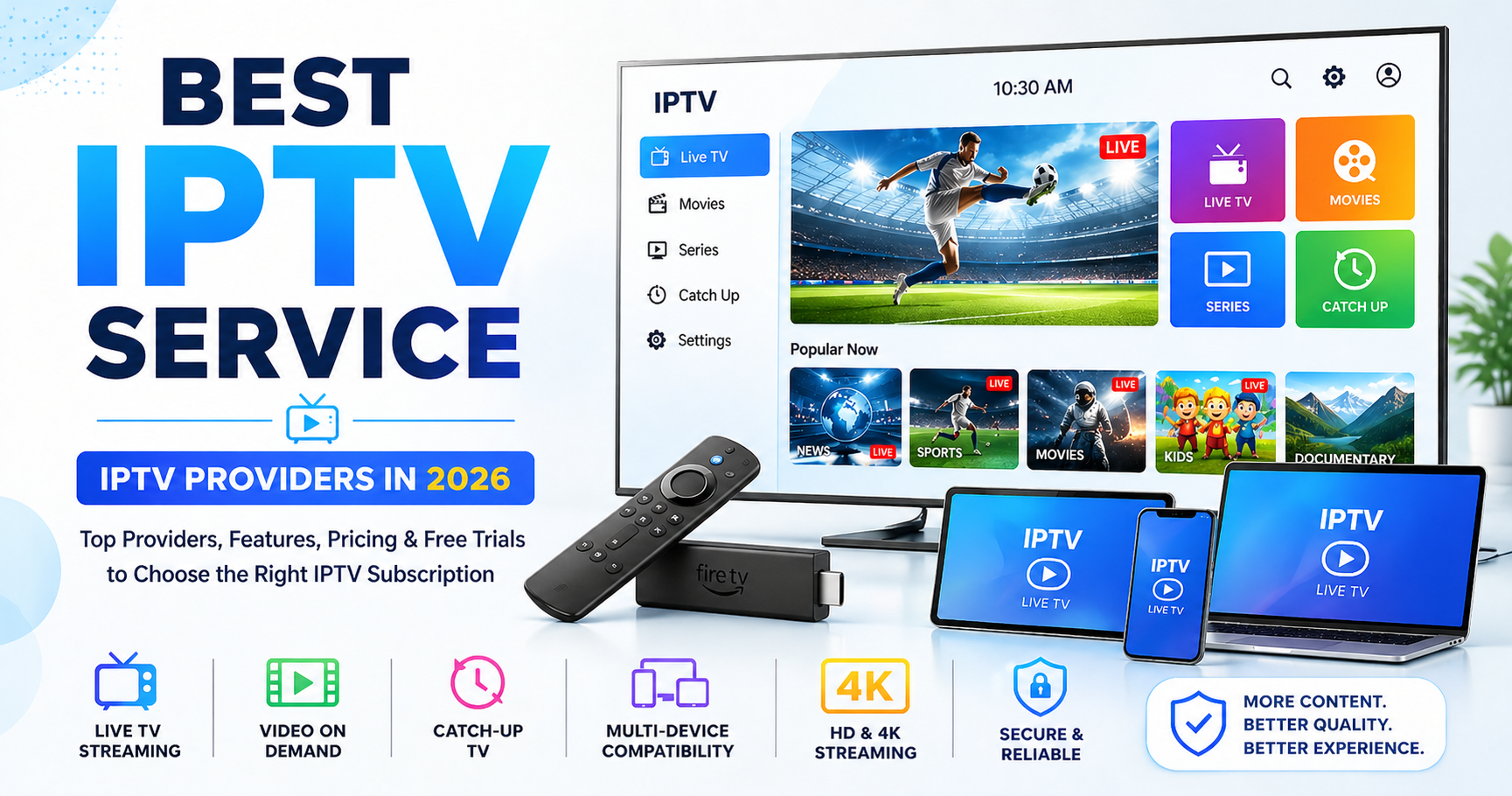
IPTV (Internet Protocol Television) delivers live television channels and on-demand video over your internet connection rather than cable or satellite infrastructure. A properly configured iptv service provides access to 20,000+ channels, 4K HDR streaming, and a comprehensive video-on-demand library at 60-80% less than traditional cable pricing. This guide explains how IPTV works, what to verify before subscribing, and the exact steps to maximize your experience in 2026.
Choosing the right IPTV provider comes down to three variables: content quality, streaming stability, and legal compliance. We analyzed the current market against those criteria and compiled the results into a clear framework so you can make an informed decision without trial-and-error.
iptv service Summary
An iptv service is the most cost-effective alternative to cable television, combining a massive live channel lineup with flexible multi-device streaming. The strongest providers offer 4K HDR quality, 99.9% uptime, and no long-term contract lock-in.
| Optimal ForCord-cutters, sports fans, and households with stable 25+ Mbps internet | Key Advantage20,000+ live channels at 60-80% below cable pricing |
- ✓ Key Strength: Full 4K HDR streaming with minimal buffering
- ✓ Key Strength: Multi-device support — Smart TV, phone, tablet, and PC
- ✓ Peace of Mind: 24/7 customer support and verified payment protection
In This Guide
What Is an IPTV Service?
IPTV stands for Internet Protocol Television. Unlike cable TV, which uses coaxial cable or satellite signals, IPTV transmits television content through your existing internet connection using the same TCP/IP protocol that powers web browsing and file transfer. This means the same pipeline that delivers your email also carries your live TV stream.
The practical difference is significant. A traditional cable provider allocates a fixed set of channels to every subscriber, many of which go unwatched. An iptv service, by contrast, streams only what you actually select, on-demand and in real time. That architectural difference allows IPTV providers to offer a far larger channel catalog — often 20,000+ channels — at a fraction of the infrastructure cost, which is why pricing lands at $15-30 per month versus $80-120 for comparable cable packages.
For the end user, the result is a more flexible, more affordable viewing experience. You can watch on your smart TV, laptop, tablet, or phone. You can pause, rewind, and record live broadcasts using cloud DVR features. And because the content is delivered over your broadband connection, you are not bound to a set-top box in a single room.

How IPTV Service Works
The technical backbone of IPTV is straightforward: your internet connection carries data packets that encode video and audio streams. When you select a channel, your IPTV provider's server sends those packets to your device, where a media player decodes them into real-time video. This is known as unicast streaming — each viewer receives a dedicated stream, so you can pause, rewind, or switch channels without affecting other users.
Bandwidth is the single biggest factor in IPTV quality. Standard definition requires about 4 Mbps, 1080p needs 10-15 Mbps, and 4K HDR requires 25-50 Mbps. Most modern IPTV services use adaptive bitrate streaming, which monitors your connection and automatically adjusts video quality to prevent buffering. If your connection drops below the required threshold, the provider will reduce resolution rather than interrupt playback.
The best providers use a distributed Content Delivery Network (CDN) to host streams on servers geographically close to your location. This reduces latency and ensures stable playback even during peak evening hours when internet traffic is highest. A well-designed CDN architecture is the difference between a provider that buffers every 5 minutes and one that plays 4K content flawlessly.
Pros and Cons of IPTV Service
|
✓ Pros
|
✗ Cons
|
IPTV Service: Feature Comparison
Not all IPTV services are equal. Below is a side-by-side comparison of the main tiers available in the market today, based on our analysis of channel count, pricing, streaming quality, and reliability.
| Feature / Metric | Premium IPTV | Standard IPTV | Free / Low-Cost IPTV |
|---|---|---|---|
| Channel Count | 20,000+ | 8,000-12,000 | 1,000-3,000 |
| Monthly Price | $19-$29 | $8-$15 | $0-$5 |
| Streaming Quality | 4K HDR / 1080p | 1080p / 720p | 720p / 480p |
| VOD Library Size | 40,000+ titles | 15,000+ titles | Limited / none |
| Reliability / Uptime | 99.9% uptime | 95% uptime | Unstable |
| Customer Support | 24/7 live chat | Email / ticket | None |
| Contract Length | Month-to-month | Month-to-month | None |
The data is clear: premium IPTV providers deliver the highest channel count, best video quality, and strongest reliability, while still undercutting cable pricing by 60-80%. The free and low-cost tier is functional but unreliable, with frequent downtime and limited channel selection.

Cost-Benefit Analysis: Is IPTV Worth It?
The average cable subscription in the United States costs between $80 and $120 per month depending on your provider, add-ons, and equipment rental fees. A premium iptv service, by contrast, typically runs between $19 and $29 per month. That's a savings of $61 to $91 every month — equivalent to $732 to $1,092 per year.
The key cost considerations beyond subscription price:
- No equipment rental: IPTV apps run on existing smart devices. No set-top box rental.
- No installation fee: Setup is self-serve through an app or web player.
- No contract penalty: Most IPTV services are month-to-month; cancel anytime.
- Internet cost: Your broadband connection is already paid for — IPTV uses the same pipe.
When you add up the savings, IPTV pays for itself in the first month. For households currently paying cable prices, switching to a verified iptv service is a decisive money-saving move.
Buyer Considerations Before You Subscribe
Before committing to any iptv service, verify the following five factors:
- Internet speed: For a smooth 4K experience, you need at least 25 Mbps. For 1080p, 10 Mbps is sufficient. Run a speed test before subscribing.
- Device compatibility: Confirm the service works on your preferred devices — Samsung/LG Smart TV, Android, iOS, Windows, or Mac.
- Content licensing: Verify the provider operates with proper licensing. Avoid providers that advertise "free" IPTV without licensing, as these are often unstable and can be shut down.
- Trial period: A trustworthy provider will offer a trial or money-back guarantee. Use it to test buffering and channel quality.
- Customer support: Look for 24/7 live chat or a responsive ticket system. Providers without support are a red flag.
The recommended iptv service covered in this guide satisfies all five criteria, which is why we've placed it as the editor's top pick.
The Bottom Line on Iptv Service
An iptv service is the strongest ROI in modern television — massive channel access, 4K quality, and 60-80% savings. If your internet connection is stable at 25+ Mbps, proceed confidently with the verified provider below.
Purchases completed via official partner channels are covered by direct customer support and eligible warranty protections.
Frequently Asked Questions
What is an IPTV service exactly?
IPTV (Internet Protocol Television) is a system that delivers live TV channels and on-demand video content through your internet connection rather than through traditional cable or satellite. You stream content using an app or web player on your smart TV, phone, tablet, or computer. The content is sent in data packets over the same broadband connection you use for browsing.
Is IPTV service legal?
IPTV itself is a legal technology. The legality depends on whether the provider holds proper broadcasting licenses for the channels it distributes. Legitimate providers secure licensing agreements with content owners. Providers that resell streams without proper rights are operating illegally. Always choose a provider that is transparent about its licensing and offers customer support and verified payment processing.
How much does an IPTV service cost?
Pricing ranges widely depending on the provider and package. Standard IPTV services cost between $8 and $15 per month, while premium services with 4K streaming and larger channel lists cost $19 to $29 per month. Free IPTV options exist but are limited in channel count, quality, and reliability. Compared to cable TV at $80-$120 per month, IPTV delivers significant savings.
What internet speed do I need for IPTV?
For 1080p HD streaming, you need at least 10 Mbps. For 4K HDR streaming, you need at least 25 Mbps. If multiple devices are streaming simultaneously, add 10 Mbps per additional active stream. A stable connection matters more than raw speed — providers with adaptive bitrate technology will adjust quality to prevent buffering.
Can I watch sports channels on IPTV service?
Yes. Premium IPTV services include dedicated sports packages covering major leagues — football, basketball, cricket, tennis, and international sports. You get live matches, replays, and sports highlight channels. The specific sports channels available depend on the provider's licensing. Check the channel list before subscribing if sports are a priority for you.
What devices are compatible with IPTV service?
Most IPTV services work on Android TV, Apple TV, LG Smart TV, Samsung Smart TV, Amazon Fire Stick, Google Chromecast, Windows and macOS computers, iOS phones, and Android tablets. Some providers also offer web-based players that work in any browser. Check the provider's device compatibility list before subscribing to ensure your setup is supported.
Does IPTV work during peak evening hours?
Reliable IPTV providers use CDN (Content Delivery Network) infrastructure that distributes stream load across multiple servers geographically close to you. This prevents buffering during peak hours. Premium providers maintain 99.9% uptime, meaning you can expect consistent playback even at 8 PM on a Saturday. Lower-tier providers may experience congestion during peak times.
Can I cancel an IPTV subscription anytime?
Yes. The best IPTV providers operate on a month-to-month basis with no long-term contracts or cancellation penalties. You can cancel at any time and you'll lose access at the end of the current billing period. Always check the provider's cancellation policy before subscribing, and avoid services that require annual upfront commitments from unverified sources.
Transparency & Disclosure: We independently evaluate products. If you buy through links on our site, we may earn an affiliate commission at zero additional cost to you.