IPTV services deliver live television and on-demand video over an internet connection instead of traditional cable, satellite, or terrestrial broadcast signals. Rather than receiving a fixed broadcast schedule through coaxial cable or a satellite dish, your TV or streaming device receives encoded video packets through your broadband line. The practical result: you can watch live sports, news, international channels, and movies on smart TVs, phones, tablets, and PCs—often at a lower monthly cost than conventional cable. However, quality, channel selection, reliability, and legal status vary dramatically between providers, so choosing correctly matters.
This guide breaks down exactly how IPTV works, what to look for in a provider, which service categories exist, and how to avoid the traps that lead to buffering, downtime, or legal trouble. You will also find a direct comparison of the four main provider types, a cost-benefit analysis, and clear answers to the questions subscribers ask most.
iptv services Summary
IPTV services replace the traditional cable bundle with internet-delivered live channels, time-shifted replays, and on-demand libraries at a fraction of the cost. The best providers combine licensed content, adaptive streaming technology, and multi-device support to deliver a stable, cable-grade viewing experience.
| Optimal ForCord-cutters and international households wanting broad live-channel access without a cable contract. | Key AdvantageLive TV plus on-demand libraries delivered to any internet-connected screen, with no long-term commitment. |
- ✓ Key Strength: Channel libraries frequently exceed 10,000 live channels across sports, news, entertainment, and international content.
- ✓ Key Strength: Native apps and compatibility with Smart TV, Android, iOS, Fire TV, and PC platforms.
- ✓ Peace of Mind: Verified provider relationships, 24/7 customer support, and direct replacement guarantees.
In This Guide
What Are IPTV Services and How Do They Work?
IPTV stands for Internet Protocol Television. Instead of receiving broadcast signals over the air, through a satellite dish, or via coaxial cable, the provider encodes television channels and video-on-demand titles into IP data packets and streams them over your broadband connection. When you select a channel, your device sends a request to the provider's server, which responds with a real-time video stream. This two-way, on-demand architecture is what separates IPTV from traditional linear broadcasting.
Industry analysts typically divide IPTV services into three categories. Live television streams broadcast channels in real time, exactly like cable but delivered over IP. Time-shifted television lets you replay previously aired programs, similar to a network DVR. Video-on-demand (VOD) gives you access to a searchable library of movies and series that you can start, pause, and resume at will. Most premium IPTV subscriptions bundle all three into a single package.
Quality depends heavily on the streaming protocol and the provider's infrastructure. Reputable services use adaptive bitrate streaming, which continuously adjusts video resolution based on your available bandwidth. A 4K stream typically requires 25 Mbps, 1080p requires around 10 Mbps, and 720p works at roughly 5 Mbps. Providers with robust server networks and CDN (content delivery network) distribution deliver far more consistent frame rates and lower latency than providers operating from a single server.
IPTV is often confused with over-the-top (OTT) streaming services like Netflix or Hulu. The distinction matters. OTT services ride on the open internet and are accessible to anyone with a connection. IPTV services traditionally operate over a managed, private network with dedicated bandwidth, which is why telecom providers favor IPTV for delivering broadcast-quality television. In practice, however, most consumer IPTV subscriptions use ordinary broadband connections, so the line between IPTV and OTT has blurred. What remains distinct is the content structure: IPTV emphasizes live channels and broadcast schedules, while OTT emphasizes on-demand libraries.
The legal status of IPTV services is a critical distinction. Licensed services—such as those offered by telecom operators or official streaming platforms—have negotiated broadcast rights with content owners. Unlicensed gray-market services often rebroadcast premium channels without authorization. While the technology itself is perfectly legal, the content source determines whether a specific service operates within the law. Subscribers in some jurisdictions have faced legal notices for using unlicensed services, so verifying a provider's licensing status is not optional.
Before subscribing, investigate the provider's infrastructure. A reputable IPTV service will have servers distributed across multiple data centers, a content delivery network for reducing latency, and adaptive bitrate streaming that adjusts quality in real time. Providers that operate from a single server location will struggle during peak evening hours, especially for live sports events with high viewership. Look for transparency about server locations, uptime statistics, and connection limits.
Pros, Cons, and Comparative Data
No single IPTV service fits every viewer. The right choice depends on your viewing habits, technical setup, budget, and tolerance for risk. The table below compares the four main categories of IPTV services you will encounter in 2026.
| Feature / Metric | Licensed Premium | Gray-Market | Cable-Provider IPTV | Free Ad-Supported |
|---|---|---|---|---|
| Typical Monthly Cost | $15–$30 | $8–$15 | $40–$120 | $0 |
| Channel Count | 5,000–15,000 | 10,000–20,000+ | 200–500 | 100–1,000 |
| Legal Certainty | Full licensing | Unlicensed, risky | Full licensing | Full licensing |
| Stream Reliability | 99.9% uptime | Variable | 99.9% uptime | Variable |
| Customer Support | 24/7 live chat | Limited or none | Phone + chat | None |
| Device Support | Smart TV, mobile, PC, tablet | Smart TV, mobile, PC | Proprietary set-top box | Web browser, mobile |
| VOD Library | 20,000+ titles | 10,000+ titles | Limited | Limited |
The data reveals a clear pattern. Licensed premium services offer the best balance of cost, reliability, and legal safety for most households. Gray-market services tempt with lower prices and larger channel counts, but the trade-offs—legal exposure, sudden shutdowns, malware risks, and zero support—make them a poor value in the long run. Cable-provider IPTV is dependable but expensive, and free ad-supported services are best treated as a supplement rather than a primary television solution.
✓ Advantages of IPTV Services
|
✗ Limitations to Consider
|
Cost-Benefit Analysis and Buyer Considerations
A legitimate IPTV subscription typically costs between $15 and $30 per month. For that price you receive several thousand live channels, a VOD library with tens of thousands of titles, and multi-device access. Cable television in the United States averages $83 per month for 125 channels, according to 2025 FCC data. The value gap is substantial, but only if the service remains stable and the content is licensed.
Your connection quality is the single largest variable in IPTV performance. For a household streaming on one screen, 25 Mbps is the recommended baseline. For simultaneous streams on multiple devices, 50 Mbps or higher is safer. Wired Ethernet connections outperform Wi-Fi for 4K content, and a router with QoS (Quality of Service) settings can prioritize video traffic. Latency and jitter also matter; a stable 30 Mbps connection with low latency will outperform an unstable 100 Mbps connection for live sports.
IPTV services are best suited to cord-cutters, expatriates seeking home-country channels, sports fans who want international league coverage, and households that want to replace a cable bill with a lower-cost alternative. They are less suitable for viewers in rural areas with unreliable broadband, or for users who are uncomfortable verifying a provider's licensing status. If you fall into the latter group, a licensed premium service eliminates that uncertainty entirely.
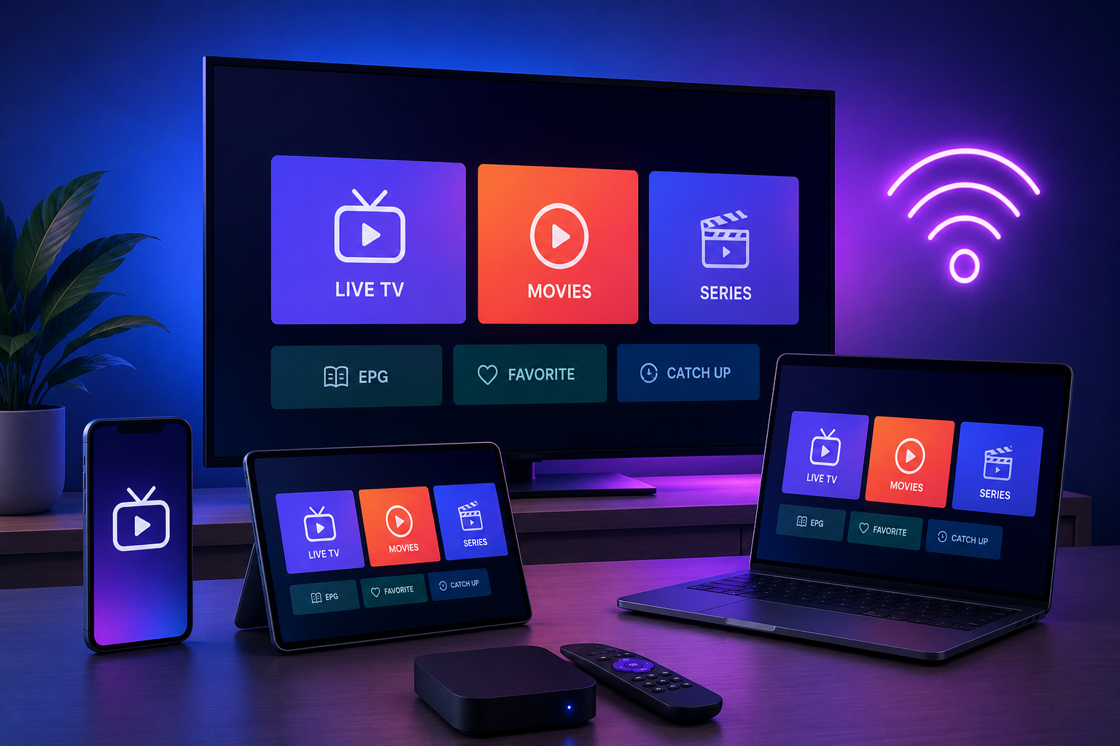
Setup is straightforward with a quality service. After subscribing, you receive login credentials and a download link for the provider's app or a playlist URL for IPTV player applications. Install the app on your preferred device, enter your credentials, and the electronic program guide populates with available channels. Popular IPTV player apps include TiviMate, IPTV Smarters Pro, and IBO Player. Some services also offer MAG box support or Enigma2 compatibility for advanced users.
Never commit to a long-term plan before testing. The best IPTV services offer a 24-hour or 7-day trial for a nominal fee. Use the trial to evaluate channel availability, stream stability during peak hours (7–11 PM), EPG accuracy, and customer support response time. Test on every device you plan to use. If the trial period reveals persistent buffering, missing channels, or unresponsive support, move on to another provider.
Avoid providers that only accept cryptocurrency, have no physical address, or refuse to answer support questions before purchase. Check for a free trial or short-term plan before committing. Read recent reviews on independent forums rather than promotional websites. A provider that has operated consistently for more than three years with verifiable licensing is a far safer bet than a newly launched service with aggressive discount pricing.
The Bottom Line on Iptv Services
If you want a legal, stable, and cost-effective replacement for cable television, a verified premium IPTV subscription is the strongest option available today. Proceed with the official provider below to lock in current pricing and a full warranty.
Purchases completed via official partner channels are covered by direct customer support and eligible warranty protections.
Frequently Asked Questions
Are IPTV services legal?
Yes, IPTV technology is legal. The legality of a specific service depends on whether the provider holds broadcast rights for the content it streams. Licensed providers are fully legal; unlicensed gray-market services operate outside content licensing agreements and may expose subscribers to legal risk in some jurisdictions.
What internet speed do I need for IPTV?
Standard definition streams require 3–5 Mbps. High definition (1080p) requires 10 Mbps. 4K UHD streams require 25 Mbps per device. For households with multiple simultaneous streams, a 50–100 Mbps connection is recommended. Latency and jitter also matter, so a stable wired connection outperforms Wi-Fi for live sports.
Can I watch IPTV on my smart TV?
Most premium IPTV services provide native apps for Samsung, LG, and Android TV platforms. Alternatively, you can use an Amazon Fire Stick, Apple TV, or Android TV box. Some providers also support screen mirroring from a mobile device. Always confirm device compatibility before subscribing.
What's the difference between IPTV and Netflix?
Netflix is a video-on-demand service that streams licensed movies and series from its own catalog. IPTV services deliver live television channels in real time, plus time-shifted replays and VOD libraries. The closest comparison is IPTV replacing cable TV, while Netflix replaces the DVD rental store.
Do IPTV services include sports packages?
Many premium IPTV providers offer dedicated sports tiers with international leagues, pay-per-view events, and 24/7 sports news channels. However, the availability of specific leagues varies by region and licensing agreements. Check the channel list for your preferred competitions before subscribing.
How much do IPTV services cost per month?
Licensed premium IPTV services typically range from $15 to $30 per month. Gray-market services may cost $8 to $15 per month but carry legal and reliability risks. Cable-provider IPTV bundles range from $40 to $120 per month. Free ad-supported IPTV services exist but offer limited channel selection.
Can I use IPTV services while traveling?
Yes, IPTV services work anywhere you have an internet connection. You can log in on a laptop, phone, or tablet while traveling. Some providers restrict simultaneous streams or use geo-blocking for certain channels, so verify the provider's policy on international usage before subscribing.
What happens if my IPTV stream buffers?
Buffering is usually caused by insufficient bandwidth, Wi-Fi congestion, or provider server overload. First test your connection speed at the device. Then try restarting your router, using Ethernet, or lowering the stream quality. If buffering persists across multiple devices and times, the provider's infrastructure is likely the bottleneck, and a service change may be necessary.
Transparency & Disclosure: We independently evaluate products. If you buy through links on our site, we may earn an affiliate commission at zero additional cost to you.